In this guide
- When is each region in season?
- What is the atmosphere like?
- What are the weather and wind like?
- How much ground can you cover in a week?
- Price: does one cost more than the other?
- Christmas and New Year in the Caribbean
- Which weeks are busiest?
- Getting there
- How long should the charter be?
- Is one easier for a first charter?
- Who suits which?
- Questions to settle before choosing
- What to send to compare the two seas
The calendar often decides first, because the two seasons barely overlap: many large yachts spend the summer in the Mediterranean and cross the Atlantic for the Caribbean winter, so the yacht you liked in Mallorca in August may be available in Antigua in February. After the dates, the kind of holiday decides the rest: the Mediterranean is about places (old harbour towns, restaurants ashore, beach clubs, culture), the Caribbean about the water (warm sun when Europe is cold, short hops between islands, long days swimming and on the beach).
The money works differently too. Charters that start in most Mediterranean countries pay VAT on top of the rate: Ocean Independence’s November 2025 summary lists 13% in Croatia, 20% in France, 21% in Spain, 22% in Italy and 24% in Greece; France, Italy and Greece allow reductions depending on the itinerary, Spain does not. Most Caribbean islands charge no VAT on charter, but several have their own fees and taxes. Below, region by region, is what changes and who each one suits.
When is each region in season?
The Mediterranean from May to October, with high season from late June to August; the Caribbean from December to April, with its peak over Christmas and New Year. The two seasons barely overlap, and that is not a coincidence: many large yachts spend the summer in the Mediterranean and cross the Atlantic for the winter season in the Caribbean.
| Mediterranean | Caribbean | |
|---|---|---|
| High season | Late June to August | December to April |
| Shoulder season | May, September, early October | — |
| Quieter period | November to April (many large yachts cross to the Caribbean, per Y.CO) | May to November (hurricane season from June) |
| Peak dates | July and August, plus event weeks | Christmas and New Year |
CharterWorld gives the Mediterranean high season as late June through August, with May, September and early October as shoulder months with “warm seas and gentler breezes”. It gives December through April as the Caribbean season, and May to November as the quieter period, which it notes is technically hurricane season.
Hurricane season in the Caribbean
The official Atlantic hurricane season, according to the US National Hurricane Center, runs from 1 June to 30 November, with its peak on 10 September and most activity between mid-August and mid-October. That is why the Caribbean charter season is a winter season. Some yachts do operate in the islands in summer, but those are the hurricane months. If you want the Caribbean, plan for December to April.
Moving between the two
Y.CO describes the standard migration: in late autumn, yachts leave the western Mediterranean, typically refuel in Gibraltar, stop in the Canary Islands and cross about 4,000 nautical miles to the Caribbean, roughly 14 days at 12 knots, plus time waiting for weather. In spring they return via the Azores. This affects you in two ways. First, the yacht you liked in Mallorca in August may be available in Antigua in February. Second, around the crossing (from the end of November, and in April or May) the yachts making it are on passage and cannot be chartered for those weeks. Our guide on when to book a yacht charter covers these repositioning periods.
What is the atmosphere like?
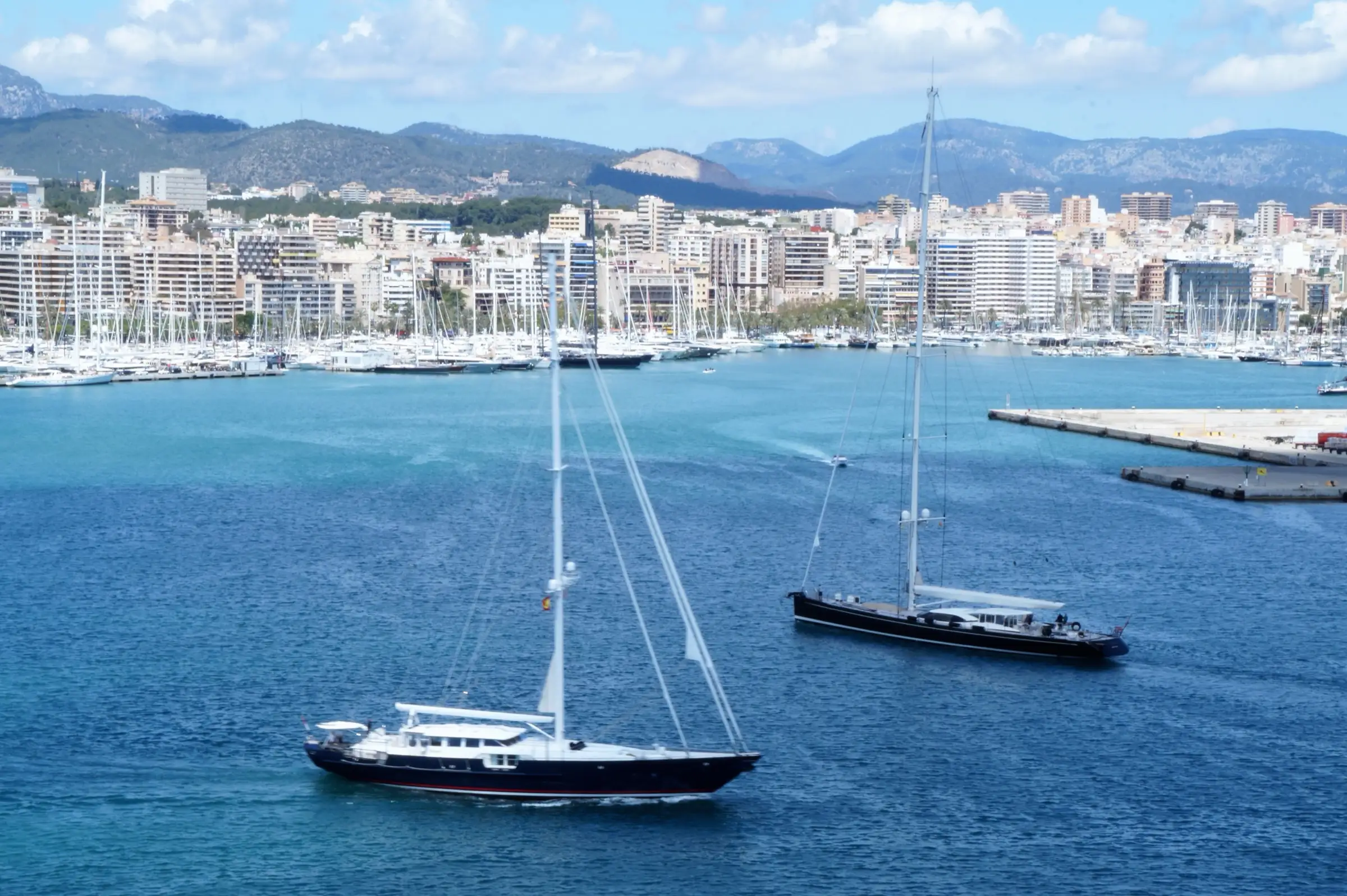
The Mediterranean mixes sea and shore in the same day, with a different town or coastline each time; the Caribbean revolves around the water, with warm sea, white beaches and snorkelling, and less town life outside a few islands such as St Barths.
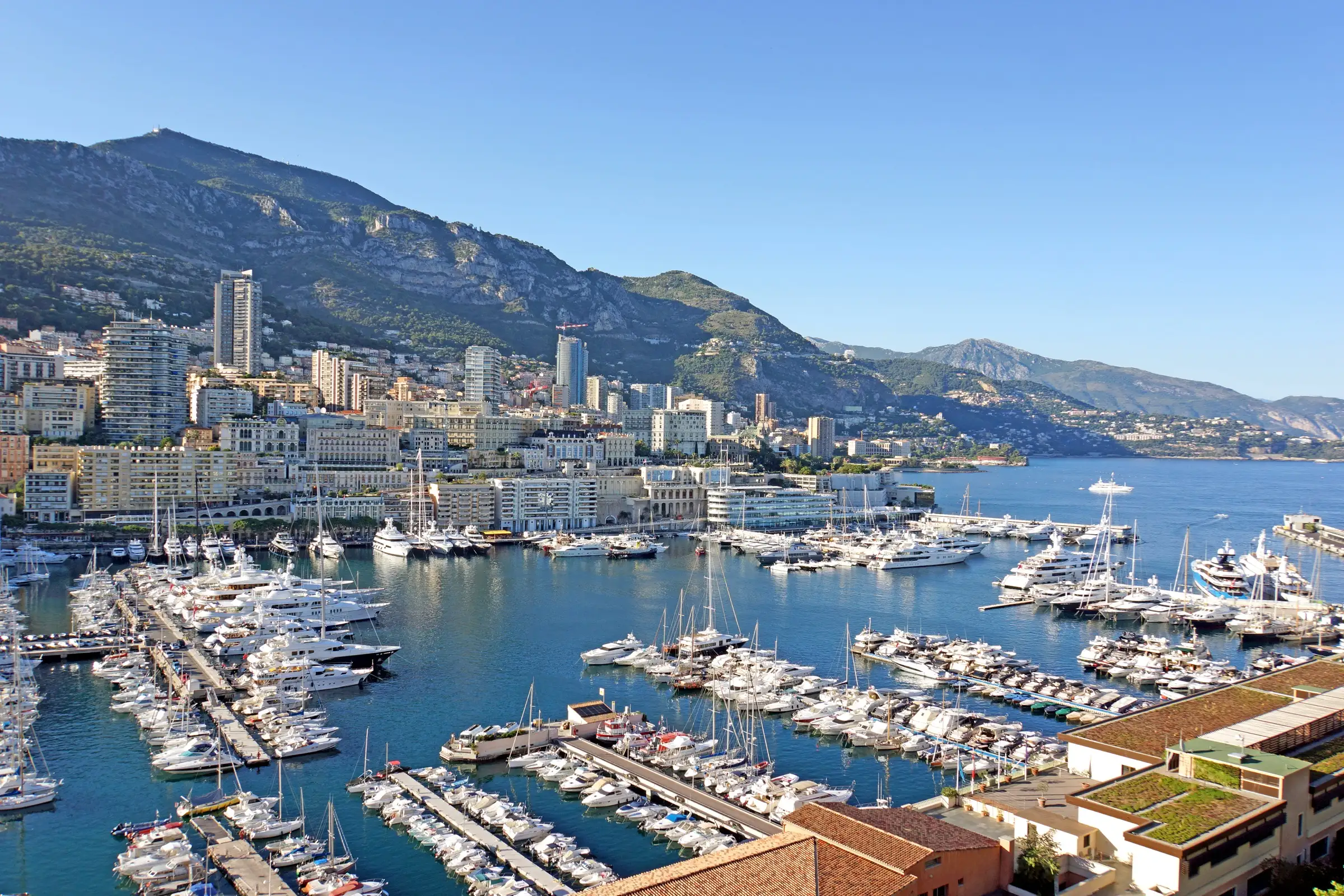
Mediterranean: coastlines with towns
The Mediterranean is a charter of contrasts within a day: a swim in a quiet bay in the morning, lunch at a restaurant on the beach, an evening walk in a harbour town. The regions are very different from each other:
- Balearics (Ibiza and Formentera, Mallorca): beach clubs, bays, short distances, lively nightlife.
- French Riviera and Monaco: harbour glamour, events, restaurants, art.
- Amalfi Coast and Capri: cliffs, villages, food, and some of the busiest summer waters in the Med.
- Sardinia and Corsica: more nature, granite bays, national parks.
- Croatia: islands, old towns and many anchorages in a compact area.
- Greek islands: island hopping, whitewashed villages, and the strong summer wind in the Aegean.
If shore life, culture, gastronomy and variety matter to you, the Mediterranean is hard to beat.
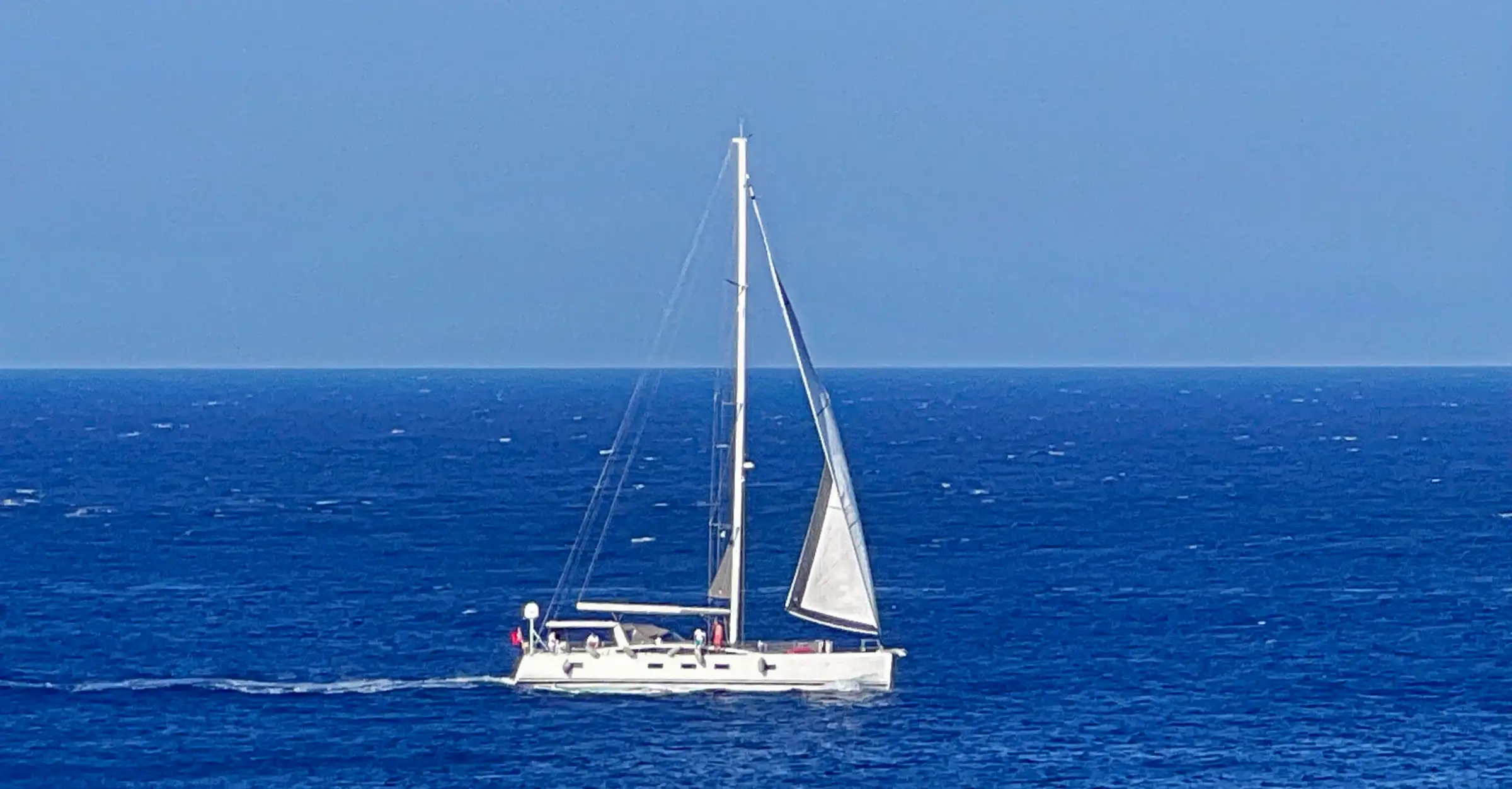
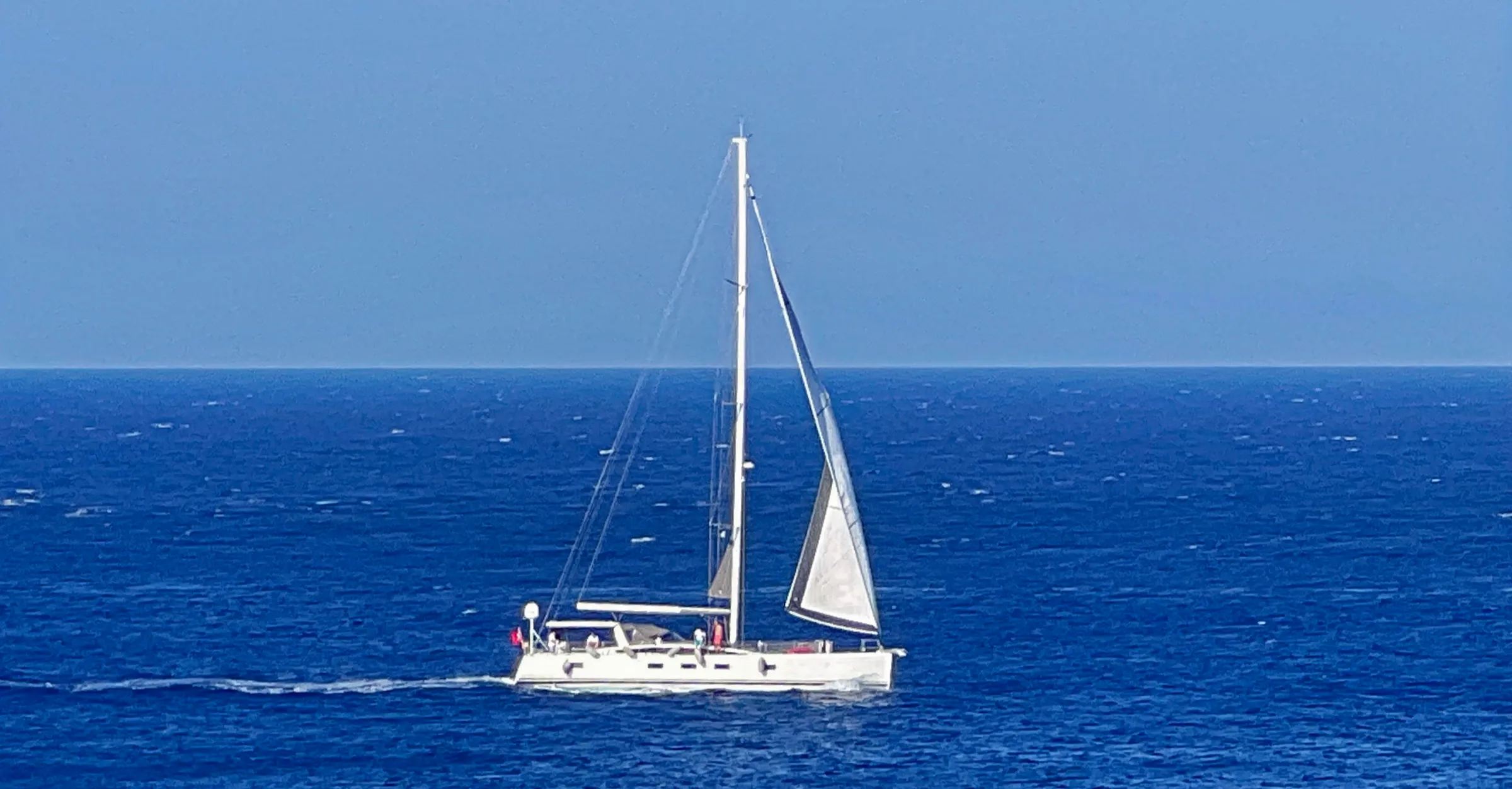
Caribbean: islands, water and beach
The Caribbean is about the sea itself: warm water, white beaches, snorkelling, barefoot beach bars. The islands have their own identities: the British Virgin Islands are a compact sailing ground with many sheltered anchorages; St Barths and St Martin mix French chic with beaches; Antigua is a sailing and harbour hub; the Grenadines are more remote and quieter; the Bahamas are shallow banks and sand. Shore life exists, especially in St Barths, but the day revolves more around the water than around towns.
Island by island, the Caribbean destination page goes into each area.
What are the weather and wind like?
A Mediterranean summer is hot, with winds that vary by region: a strong mistral can blow between Sardinia and Corsica even in midsummer, and the meltemi can blow hard in the Aegean. A Caribbean winter brings steady trade winds from the east and north-east, often 15–25 knots according to First Class Sailing.
| Mediterranean (summer) | Caribbean (winter) | |
|---|---|---|
| Typical wind | Varies by region; local winds such as the mistral (Sardinia/Corsica) and meltemi (Aegean) | Trade winds from the east and north-east |
| Strength | Strong mistral regularly between Sardinia and Corsica, even in midsummer; Aegean can be strong in July–September (Yacht) | Often 15–25 knots, December to early April (First Class Sailing) |
| Sea state | Rough seas in unprotected areas when the meltemi blows (Yacht) | Open-water swell between islands; calm in the lee |
| Air temperature | Hot in July–August | Burgess gives an average daily temperature in late December of 23–26 °C |
Two winds are worth knowing about. In the Aegean, the meltemi blows most strongly over the Cyclades in July, August and September, according to the German sailing magazine Yacht, whose reporter had forecasts of six to nine Beaufort during a single week in mid-October. It shapes the itinerary and the comfort of passages, and Yacht notes that it causes rough seas in unprotected areas. In the Caribbean, the trades are steady and reliable, typically 15–25 knots from December to early April. That is excellent for sailing yachts and catamarans; on a motor yacht, open crossings between islands can be lively, and the lee side of each island is where you will anchor.
How much ground can you cover in a week?
Both regions offer short hops, but the geometry is different: the Mediterranean is mostly coast and island clusters a few hours apart, while each Caribbean area is a group of islands with open water in between, so a week fits one area more comfortably than several.
In the Mediterranean, most charter areas are a stretch of coast or a cluster of islands. Some combinations are classic (Ibiza–Formentera, Amalfi–Capri, Split–Hvar–Vis), and some longer ones (Côte d’Azur to Corsica, Cyclades) need a bigger passage or two.
In the Caribbean, each cruising area is a group of islands with open water in between. Some areas are very compact, like the British Virgin Islands; others, such as Antigua to St Barths, involve a longer open-water leg. A one-week Caribbean charter fits one island group more comfortably than several.
Price: does one cost more than the other?
Not in the base rate, which depends on the yacht, its size and the week, not on the ocean. Within each region, peak weeks cost more than quieter ones. CharterWorld gives an example of a superyacht chartering under $200,000 per week in low season and over $300,000 in high season, and says the difference for smaller yachts is around 20%.
What changes between regions is what you pay on top of the base rate.
VAT and taxes
Taxes on charter change often. The figures below are those published by Ocean Independence in November 2025 and YachtCharterFleet; the agency confirms the rate that applies to your charter before you sign.
| Where the charter starts | VAT / tax on charter (2025 data) |
|---|---|
| Spain | 21% |
| France and Monaco | 20% (proportional reduction possible for time in international waters) |
| Italy | 22% (reductions possible for time outside the EU) |
| Croatia | 13% |
| Greece | Standard 24%, reduced effective rate depending on itinerary and vessel |
| Montenegro | 0% on charters starting in Montenegro (Ocean Independence) |
| Most Caribbean islands | Generally no VAT; local cruising permits and fees may apply |
| Bahamas | 14% total in YachtCharterFleet’s table (tax plus VAT) |
| British Virgin Islands | No VAT, but a per-person daily cruising permit, set in August 2017 at US$6 for BVI-based charter boats and US$16 for foreign-based ones, according to Harneys (via Legal 500). Amendments in force since June 2025 changed the fee schedule and the conditions for foreign-based yachts (O’Neal Webster); the agency confirms the current fee |
In practice: on a €200,000 week, VAT alone is €26,000 in Croatia, €40,000 in France and €42,000 in Spain. In most of the Caribbean that line disappears, though not always: the Bahamas have their own tax, and the BVI charge per person per day. See our guide to yacht charter VAT by country for the detail.
A worked example: the same base rate in Spain and in the BVI
To see how much the region changes the total, take a yacht with a base rate of €150,000 for a week and 12 guests, and use the mid-range figures from the sources above. This is an illustration of how the bill is built, not a quote.
| Charter starting in Spain | Charter in the BVI (yacht based outside the BVI) | |
|---|---|---|
| Base rate | €150,000 | €150,000 |
| APA (30%, inside the 25–40% range) | €45,000 | €45,000 |
| VAT on the charter fee | 21% = €31,500 | None |
| Local charter fee | — | US$16 × 12 guests × 7 days ≈ US$1,350 (2017 rate; confirm the current fee and conditions for foreign-based yachts) |
| Crew tip (10–20%) | €15,000–30,000 | €15,000–30,000 |
| Estimated total | about €241,500–256,500 | about €210,000–225,000 plus the BVI fee |
The APA is an advance, not a fixed cost: anything not spent is refunded, and if fuel and berths cost more, you top it up. A motor yacht running long legs every day will use more; a catamaran anchored in the same area all week will use less. Charter VAT is charged on the charter fee, not on the APA, according to IYC; the fuel, food and berths paid from the APA carry their own VAT (see our APA guide).
Contract terms
MYBA is the most widely used contract for crewed charters, according to YachtCharterFleet, and it operates under Western Mediterranean Terms (WMT): base rate plus all running expenses (fuel, food, drinks, berths), paid from the APA. YachtCharterFleet explains that in the Caribbean some yachts use other terms, such as “Caribbean Terms Inclusive”, which includes meals and a set amount of cruising per day, and that Standard Eastern Mediterranean Terms (SEMT) and Greek Terms are also used, less frequently. SEMT work much like Caribbean Terms Inclusive, but with two meals a day instead of three, because guests are assumed to dine ashore in the evening. Greek Terms are like the MYBA terms, except that harbour and berthing fees are included as long as the yacht stays in Greek waters. So when you compare a Med offer with a Caribbean one, compare the totals, not the base rates. Our guide to the MYBA contract explains what is included under each type.
APA and tips
The APA works the same way in both regions. YachtCharterFleet gives a typical range of 25–40% of the base rate for “plus expenses” charters. Crew gratuities are also customary in both, typically 10–20%, according to the same source.
Christmas and New Year in the Caribbean
The festive fortnight is the highest-demand period of the whole Caribbean season, and it comes with rules:
- Minimum stays. Burgess says most yachts tend to have a minimum 10-day booking over the festive season, with only a handful taking week-long charters.
- Early booking. Burgess notes that the best yachts are often booked up to a year in advance.
- Berths and restaurants. Prime berths in St Barths and Antigua need to be secured by the captain well in advance, and restaurants and beach clubs are at their busiest.
- Premium rates. Holiday weeks are priced above the normal winter rate; the exact premium varies by yacht and is shown in the offer.
If you are thinking of Christmas or New Year on a yacht, start as early as you can and expect the 10-day minimum that, according to Burgess, most yachts tend to have.
Which weeks are busiest?
In the Mediterranean, August and the big event weeks; in the Caribbean, the festive fortnight. High season is not one block. In the Mediterranean, the busiest weeks are in August, when much of Europe is on holiday, and the weeks of big events on the French Riviera, such as the Monaco Grand Prix and the Cannes Film Festival. In those weeks yacht prices are generally higher, according to YachtCharterFleet. In the Caribbean, the pressure point is the festive fortnight; the rest of the winter is calmer, and availability is easier to find.
If your dates are flexible, moving away from these peaks can lower the rate: YachtCharterFleet says the shoulder months can share much of the same weather as the peak season, while charter rates tend to be lower.
Getting there
From Europe, the Mediterranean is a short flight to bases such as Palma, Ibiza, Nice, Naples, Olbia, Split, Dubrovnik or Athens. You can join the yacht the same day you leave home.
The Caribbean is a long-haul flight from Europe, often with a connection to a smaller island. Arriving a day early, or starting from a main hub, avoids a tight connection. For North American guests it is the opposite: the Caribbean is a short flight, and the Mediterranean a transatlantic one.
How long should the charter be?
The standard charter in both regions is seven nights, usually from a fixed base. In the Mediterranean that is enough for a stretch of coast or an island group. In the Caribbean, a week fits one island group comfortably; trying to cover two can mean a long open-water passage in the middle of the week.
Over Christmas and New Year, Burgess says most yachts tend to have a 10-day minimum; in the BVI, Boatbookings lists fixed 7-night holiday charters (19–26 December 2026 and 28 December 2026–4 January 2027) for the yachts it offers there. Outside that, shorter charters exist but are harder to find on large yachts in peak weeks, and longer ones (ten to fourteen nights) let you combine areas without rushing.
Is one easier for a first charter?
Both work well the first time. The Mediterranean is usually easier if you want variety and a familiar setting: short flights, towns ashore, and plenty of alternatives if the weather turns. The Caribbean is easier if the group simply wants to relax: the trade winds are predictable in winter, the rhythm is slower, and most days follow the same pattern of swim, beach and sunset. What matters most in either case is choosing the right yacht and crew for the group; the destination pages and the region guides help you pick the area within each sea.
Who suits which?
The Mediterranean suits summer dates, days that mix the sea with towns and food, and families tied to school holidays; the Caribbean suits winter sun, days built around the water and anyone who enjoys a steady breeze.
Choose the Mediterranean if…
- You can travel between May and October.
- You want each day to combine a swim, a restaurant and a town.
- Culture, food and wine matter as much as the beach.
- You want a summer holiday with children during school holidays.
- You want to be close to home, with a short flight.
Choose the Caribbean if…
- You want warm sun between December and April.
- The water, beaches and snorkelling are the main event.
- You like sailing or a steady breeze.
- You want a quieter, more relaxed atmosphere outside the obvious hotspots.
- You are celebrating Christmas or New Year and can book well ahead.
Or both
Because many yachts cross the Atlantic twice a year (Y.CO), the same yacht and crew can sometimes be chartered in both seas. If you enjoyed a yacht and crew, ask the specialist where they will be in the other season.
Questions to settle before choosing
Five questions settle it, and the first one often decides on its own:
- What dates can you actually travel? That often decides the region.
- What do you want from a day: shore or water?
- Who is coming, and how far will they fly?
- What is the all-in budget? Remember VAT in the Med and local fees in the Caribbean.
- Is this a festive charter? If so, minimum stays and early booking apply.
What to send to compare the two seas
For this choice, a charter specialist mostly needs your dates and how flexible they are (a week either side of the peaks widens the choice), where the group is flying from, whether the days are about shore or water, and whether it is a festive charter. With that you can receive options in the region that fits, or in both, compared on the estimated total rather than the base rate. The charter itself is contracted with the yacht’s owner through a licensed charter agency, normally under the MYBA agreement, with the full price, VAT or local fees set out before you sign. Send your request.