In this guide
- What are the three types, in practice?
- Space: where does each type put you?
- Stability: will anyone get seasick?
- Speed and range: how much coast can you cover in a week?
- Which type burns the most fuel?
- Draught and anchorages: where can each type go?
- Which type finds a berth more easily?
- Price: what does each type cost to charter?
- How do the three compare side by side?
- Which one suits your group?
- What should you ask before you choose?
- A simple way to decide
- What to send when you are unsure of the type
None of the three is better in itself: the right one depends on who is coming, how far you want to go and how you like to spend the day. Two checks matter more than the type on any yacht: the guest licence, which caps most charter yachts at 12 guests whatever their size, and zero-speed stabilisers if anyone is prone to seasickness. Below, the three are compared on space, motion, speed, fuel, anchorages and price, with a short way to decide at the end.
What are the three types, in practice?
A motor yacht runs on its engines and gives the most volume and speed; a sailing yacht uses the wind as its main power and an engine for harbours and calms; a catamaran has two hulls joined by a wide deck, with a shallow draught and good stability. Within each type, the hull and the crew change the week as much as the label.
Motor yachts
Motor yachts range from fast planing boats to large, steel displacement yachts built to cruise for long distances. Boat International describes motor yachts as typically faster than sailing yachts, with more spacious interiors and, above 24 metres, usually three decks or more. Burgess notes that modern motor yachts have zero-speed stabilisers as standard, which reduce roll at anchor as well as underway.
Within the category, the hull shape matters more than the badge:
- Displacement hulls push through the water rather than riding on top of it. Their top speed is limited by the length of the waterline. The classic rule of thumb, which Boat International quotes, is 1.34 × the square root of the waterline length in feet. For a 150-foot waterline that gives a theoretical hull speed of about 16.4 knots. For reference, Y.CO uses an average cruising speed of 12 knots for an Atlantic crossing by superyacht.
- Semi-displacement hulls sit in between: faster than a displacement yacht, but they burn a lot more fuel to do it.
- Planing hulls lift and ride on top of the water. Burgess says fast planing models can exceed 40 knots. They are more common on smaller yachts (BOAT International explains that the larger the yacht, the harder it is to get it planing) and suit people who want to move between islands quickly.
Sailing yachts
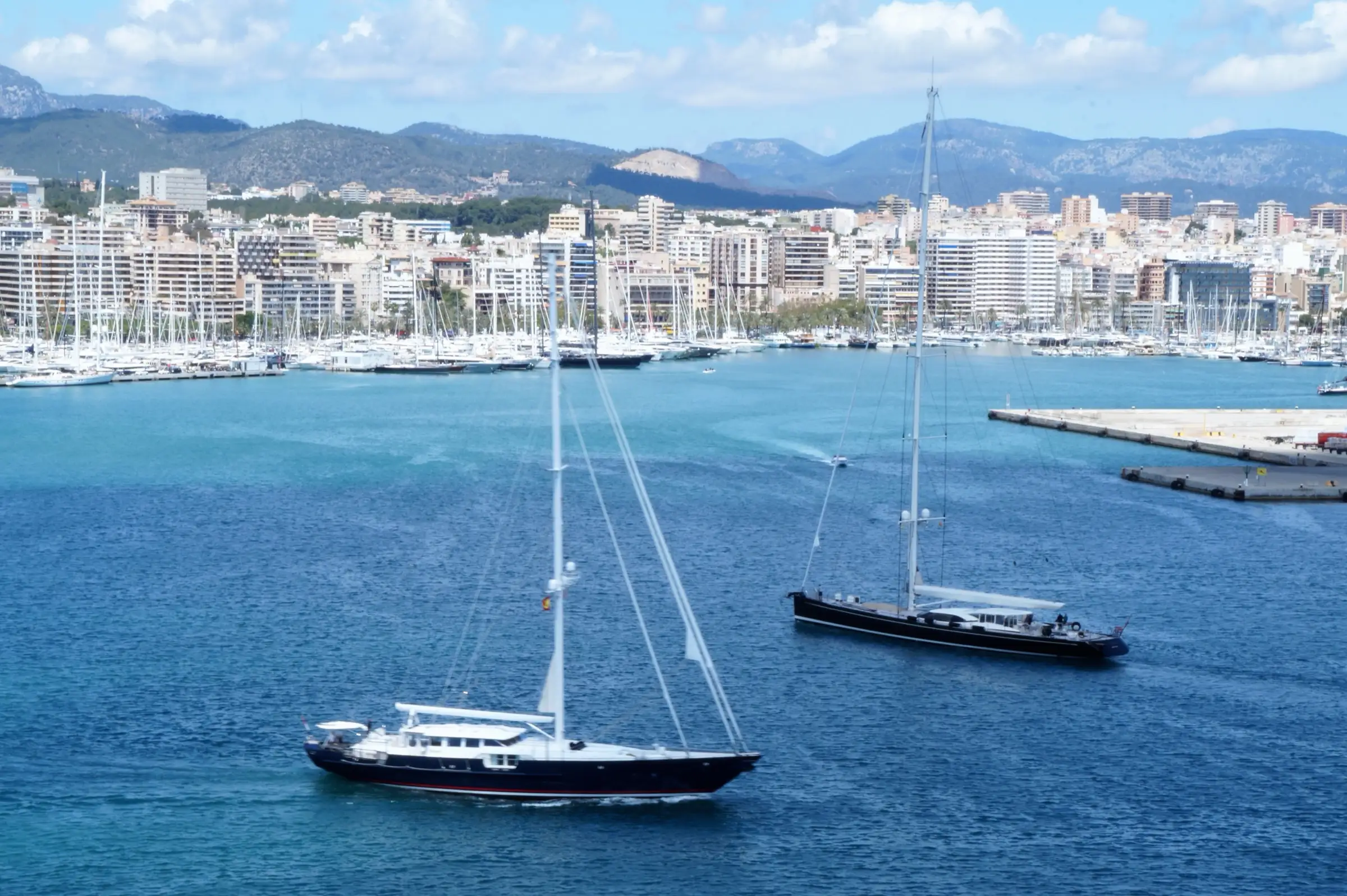
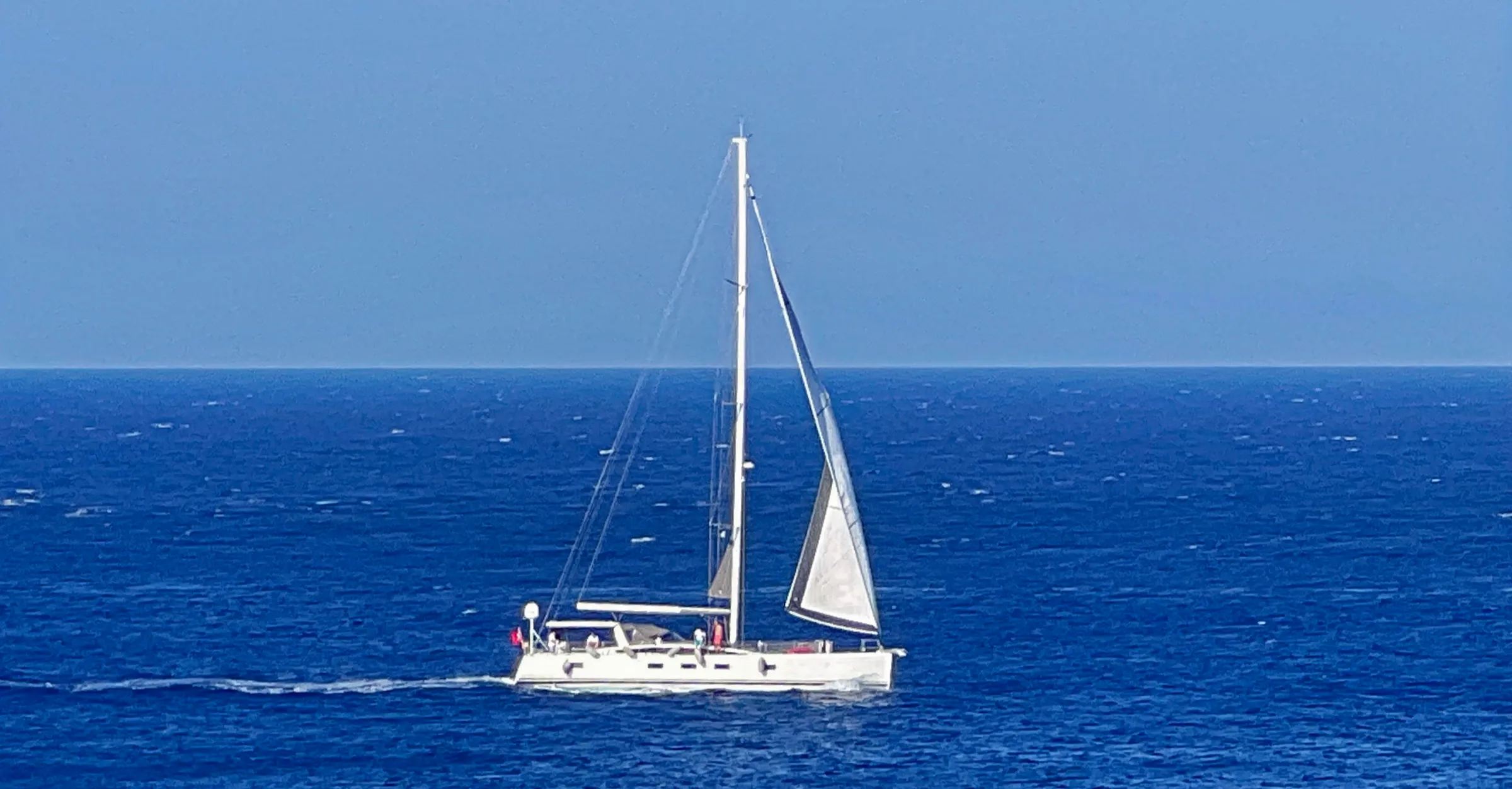
A sailing yacht uses the wind as its main power and an engine for harbours, calms and schedules. Burgess points out that interior volume is often less than on a motor yacht, and Boat International that large sailing yachts above 24 metres tend to have the guest accommodation on the lower deck and a raised saloon. You trade some space for something a motor yacht cannot offer: a quiet, engine-off passage with the boat working with the sea.
Large sailing yachts need a highly skilled crew, and the itinerary bends to the wind. On a day with the wrong wind direction, the captain will motor, or suggest a different anchorage.
Catamarans
A catamaran has two hulls joined by a wide deck. In charter you will see sailing catamarans and power catamarans. Boat International notes that multihulls are generally lighter, with a shallower draught and good stability because of their wide beam. Burgess says they are increasingly popular with guests who like to spend nights at anchor and with sailors who appreciate the lack of heeling.
Space: where does each type put you?
Motor yachts win on volume. On the same length, you get more decks, a higher interior, a larger main saloon, and there may be a sky lounge, a sundeck and a beach club or swim platform at the stern. If you are travelling with a mixed group that needs separate places to be (children, grandparents, people working for an hour a day), the extra decks are the real luxury.
Catamarans win on space for their length. Fraser’s FAQ says a catamaran offers up to twice the living space of a monohull of equivalent length, and gives an example of a 40-foot catamaran with more than 70 square metres. The cabins are split between two hulls, which gives privacy: Fraser’s example is parents having drinks on deck while the children sleep a few metres away.
Sailing yachts give the least interior volume per metre, because of the hull shape, the mast and the keel. The trade-off is the deck: long, open teak decks and a cockpit that is the centre of life on board.
One rule applies to all three: most charter yachts are licensed for a maximum of 12 guests, whatever their size. YachtCharterFleet explains that carrying more than 12 passengers puts a yacht under passenger-ship rules, so many owners cap it at 12. Its example: an 80-metre yacht with eight cabins may well sleep 16 in private use but only 12 on a commercial charter. So for big groups, do not choose by type; choose by licence, and check it early. Our guide on how to choose a charter yacht covers cabins and guest numbers in more detail.
Stability: will anyone get seasick?
A catamaran is the most level, at anchor and underway; a motor yacht with zero-speed stabilisers comes close; a monohull sailing yacht heels under sail, though Fraser notes that its deep keel adds stability when anchored in exposed conditions. The answer also depends on whether you are at anchor or underway:
| At anchor | Underway | |
|---|---|---|
| Motor yacht | Good with zero-speed stabilisers; some roll in a swell without them | Smooth at cruising speed with stabilisers; can be lively at speed in a head sea |
| Sailing yacht | The deep keel adds stability in exposed anchorages (Fraser) | Heels (leans) under sail, but the motion is steadied by the sails and keel |
| Catamaran | The most level: two hulls, no heel | Level, no heel; may shudder slightly as waves hit the bridgedeck in choppy seas |
Fraser says that on a catamaran “the deck beneath your feet remains level”, and adds the honest caveat that in choppy water the boat may shudder as waves hit the bridgedeck. On a monohull sailing yacht, heeling is part of sailing, and glasses on a table need attention.
For anyone prone to seasickness, two things matter more than the type: whether the yacht has zero-speed stabilisers (ask; they are standard on modern motor yachts, according to Burgess, but not on every older one) and where you anchor at night. A good captain will pick a sheltered anchorage over a pretty one in a swell.
Speed and range: how much coast can you cover in a week?
A planing motor yacht is the fastest (some models exceed 40 knots), a displacement motor yacht is slower (Y.CO uses a 12-knot average for a superyacht crossing the Atlantic), a catamaran keeps a good pace off the wind and a sailing yacht goes at the pace of the wind. Speed shapes the itinerary more than anything else.
| Type | What to expect | What it means for a week |
|---|---|---|
| Planing motor yacht | Fast; some models exceed 40 knots (Burgess) | Several islands, long hops in a morning, but high fuel use |
| Displacement motor yacht | Comfortable cruise; Y.CO uses a 12-knot average for an Atlantic crossing | A 36-nautical-mile hop takes about three hours at 12 knots |
| Sailing yacht | Depends on wind; often motors in light air | Shorter hops, flexible plan, passage is part of the day |
| Catamaran | Fraser: 25–30% faster than comparable monohulls on a reach or downwind | Good pace off the wind; less efficient upwind |
At 12 knots, a 36-nautical-mile hop takes three hours: a relaxed morning. At 25 knots it is under an hour and a half, but you pay for it in fuel (see below). On a sailing yacht, the same hop could take three to six hours depending on the wind, which is fine if sailing is what you came for.
If you want to see Ibiza and Formentera in one week, almost any yacht can do it, because the distances are short (see our Ibiza and Formentera guide). If you want to string together several Greek islands against the meltemi, the summer northerly wind (Sailing Issues), speed and comfort in a head sea start to matter more.
Which type burns the most fuel?
The motor yacht, by far, and on a fast one speed costs more than distance; sailing yachts and catamarans burn much less. It matters because under MYBA terms fuel is charged on top of the base rate and paid from the APA, the Advance Provisioning Allowance you deposit before the trip (YachtCharterFleet). That makes the yacht type, the hull and the itinerary big variables in the extras.
Superyacht Content gives two examples, in an article from January 2022, worth keeping in mind:
- A fast 30-metre motor yacht at 20 knots burns roughly 400–500 litres an hour, depending on the engine; the source puts the total for a 100-nautical-mile passage at 2,500 litres.
- A 70-metre yacht covering the same 100 nautical miles (Saint-Tropez to northern Corsica in their example) uses about 8,335 litres, around €7,500 at €0.90 per litre.
The same article put marine fuel prices at the time between about €0.80 and €1.30 per litre, depending on the country and whether the yacht can bunker tax-free (Gibraltar and Montenegro are their examples).
Two practical consequences:
- Speed costs more than distance. On a planing or semi-displacement yacht, slowing down saves a lot. Ask the captain for the fuel use at cruising speed and at fast cruise, and plan the long legs at the economical speed.
- Sailing yachts and catamarans burn far less. Burgess notes that sailing yachts hit the “economical sweet spot”, and Fraser says the slender hulls of a catamaran create less drag and therefore lower fuel consumption. Both still have engines and generators that run, so the fuel line is not zero.
Our guide to the APA explains how this money is spent, accounted for and refunded.
Draught and anchorages: where can each type go?
A catamaran gets closest to the beach, a sailing yacht stays furthest out because of its keel, and a motor yacht sits in between. Draught, how deep the hull sits in the water, decides how close you can anchor and which small harbours you can enter.
- Catamarans have the shallowest draught. Fraser’s FAQ gives a typical 1.2 to 1.5 metres; ask for the draught of the yacht on offer. That opens shallow bays and lets you anchor close to the beach.
- Motor yachts sit in the middle. The larger the yacht, the deeper the draught and the further out you anchor, but the tender takes you in.
- Sailing yachts have the deepest draught because of the keel. Some large sailing yachts have lifting keels, which helps, but you will often anchor further out than a catamaran of the same length.
Anchoring is also regulated. In the western Mediterranean, the protected Posidonia seagrass meadows limit where yachts can drop anchor. In France, an order of the maritime prefecture bans anchoring where it would damage protected seagrass, citing the damage done by vessels over 24 metres; in the Balearic Islands, no-anchoring zones over Posidonia have applied to every vessel since 2018 (SuperyachtNews). The rules apply to every type and the captain handles them; just be aware that the “perfect bay” you saw online may be off-limits for anchoring at your yacht’s size.
Which type finds a berth more easily?
A sailing yacht usually has no trouble; a catamaran is the one that can struggle in busy harbours. A catamaran’s width has a downside: it needs a wider berth, and Fraser notes that some marinas cannot accommodate such proportions. In high season, in the busiest harbours, this can mean a berth further out or a night at anchor instead. If you plan to spend most nights at anchor, Fraser notes that this hardly matters.
If spending evenings in a particular harbour matters to you (Saint-Tropez, Portofino, Capri), say so early; the specialist and the agency will check what is possible for the yachts on offer. Our yacht size comparison goes into this.
Price: what does each type cost to charter?
Base rates depend far more on size, age, build quality, season and destination than on type, so do not use type alone to estimate a budget. Some points do hold:
- Catamarans cost more per metre than monohull sailing yachts. Fraser says catamaran charters typically command rates 50 to 100% higher than comparable monohulls, and that the gap narrows when the cost is shared between more guests.
- The final bill differs more than the base rate. Two yachts at the same weekly rate can end up thousands of euros apart because of fuel. That is why it pays to compare offers on an estimated total: base rate + APA + VAT + crew tip.
What the rate includes is set out in the charter contract, normally the MYBA agreement. For the full breakdown of what you pay, see how much a luxury yacht charter costs.
How do the three compare side by side?
The motor yacht leads on space, decks and speed; the sailing yacht on low fuel use and the passage itself; the catamaran on a level deck, living space for its length and the shallowest draught.
| Motor yacht | Sailing yacht | Catamaran | |
|---|---|---|---|
| Interior space for its length | High | Lowest | Highest (up to 2× a monohull, Fraser) |
| Decks and separate areas | Most | Fewer | Wide single level plus flybridge |
| Motion at anchor | Good with stabilisers | Keel adds stability (Fraser) | Most level |
| Heel under way | None | Yes, under sail | None |
| Speed | Highest (planing >40 kn on some) | Wind-dependent | Good off the wind |
| Fuel use | Highest | Low | Low |
| Draught | Medium | Deepest | Shallowest (typically 1.2–1.5 m, Fraser) |
| Berths in busy harbours | Check for the yacht on offer | Usually fine | Needs wider berths |
| Suits | Mixed groups, families wanting space, island-hopping | Couples, sailors, groups who enjoy the passage | Families with children, beach and bay lovers |
Which one suits your group?
For young children, a catamaran or a stabilised motor yacht; for several generations or for covering a lot of ground, a motor yacht; for a group that comes to sail, a sailing yacht. Couples can choose any of the three.
Families with young children
Catamarans and stabilised motor yachts are the safe choices. A catamaran gives a level deck, a big shaded area between the hulls and easy access to the water. A motor yacht gives more separate spaces and usually more water toys. A monohull sailing yacht can work very well for older children who want to help on deck, but heel and steep companionways are worth thinking about with toddlers.
Multi-generation groups
A motor yacht with a lift or a main-deck cabin, stabilisers and several decks is usually the easiest. Grandparents, parents and teenagers can each have their own space, and the captain can keep passages short.
Couples and small groups
Any type works. If you have never sailed, a sailing yacht is the one that will feel most different from a hotel. If you mostly want to swim, read and eat well, a smaller motor yacht or a catamaran gives more living space for its length.
Groups who want to cover a lot of ground
A motor yacht, preferably one with an economical cruising speed that is still quick enough for your plan. Ask for an itinerary with estimated hours under way before you sign.
Groups who come to sail
A sailing yacht. Tell the specialist how much actual sailing you want, and ask how often the crew sails on charter.
What should you ask before you choose?
Start with the guest licence and the stabilisers; the rest of these questions tell you what the week will cost and where the yacht can go.
- How many guests is the yacht licensed for, and how are the cabins laid out? (Remember the 12-guest limit.)
- Does it have zero-speed stabilisers? Essential for anyone sensitive to motion.
- What is the fuel consumption at cruising speed and at fast cruise? It drives the APA.
- What is the draught? It tells you how close you will anchor.
- For sailing yachts: how often do the crew actually sail on charter?
- For catamarans: will it fit the harbours on the plan?
- What is the water-toy list, and is everything included or extra? Our water toys guide lists what to ask for.
A simple way to decide
Choose by what matters most to the group:
- If space, comfort and range are the priority: motor yacht.
- If the experience of sailing is the priority: sailing yacht.
- If calm at anchor, shallow bays and children are the priority: catamaran.
- If you cannot decide, describe the group and the kind of day you want, and let a specialist send you one of each with an estimated total cost. Comparing two or three real offers makes the choice obvious faster than any table.
What to send when you are unsure of the type
To compare motor, sail and catamaran for you, a charter specialist needs to know who is coming (ages, and anyone prone to seasickness), the area and dates, how much actual sailing you want, how far you want to go in the week and whether evenings in a particular harbour matter. With that you can receive options across the types that fit, each with the base rate and the expected extras, so you compare like for like. The charter itself is contracted with the yacht’s owner through a licensed charter agency, normally under the MYBA agreement, with the full price and VAT set out before you sign. Send your request.